Move is a smart contract programming language designed with the idea to treat digital assets like real-world resources. It was born to serve Meta’s Diem (Libra) project but has since evolved to give developers more power and bring to life community-owned solutions for various purposes.
While Move has yet to see widespread adoption, its unique features often outperform Solidity. Let’s look at how Cedra blockchain makes Move more accessible and practical, opening the way for it to become an industry standard.
Fundamentals of Move programming language
Move is designed to be, before anything else, secure, and also expressive and intuitive for developers. Speaking of its technical nature, here are its core principles:
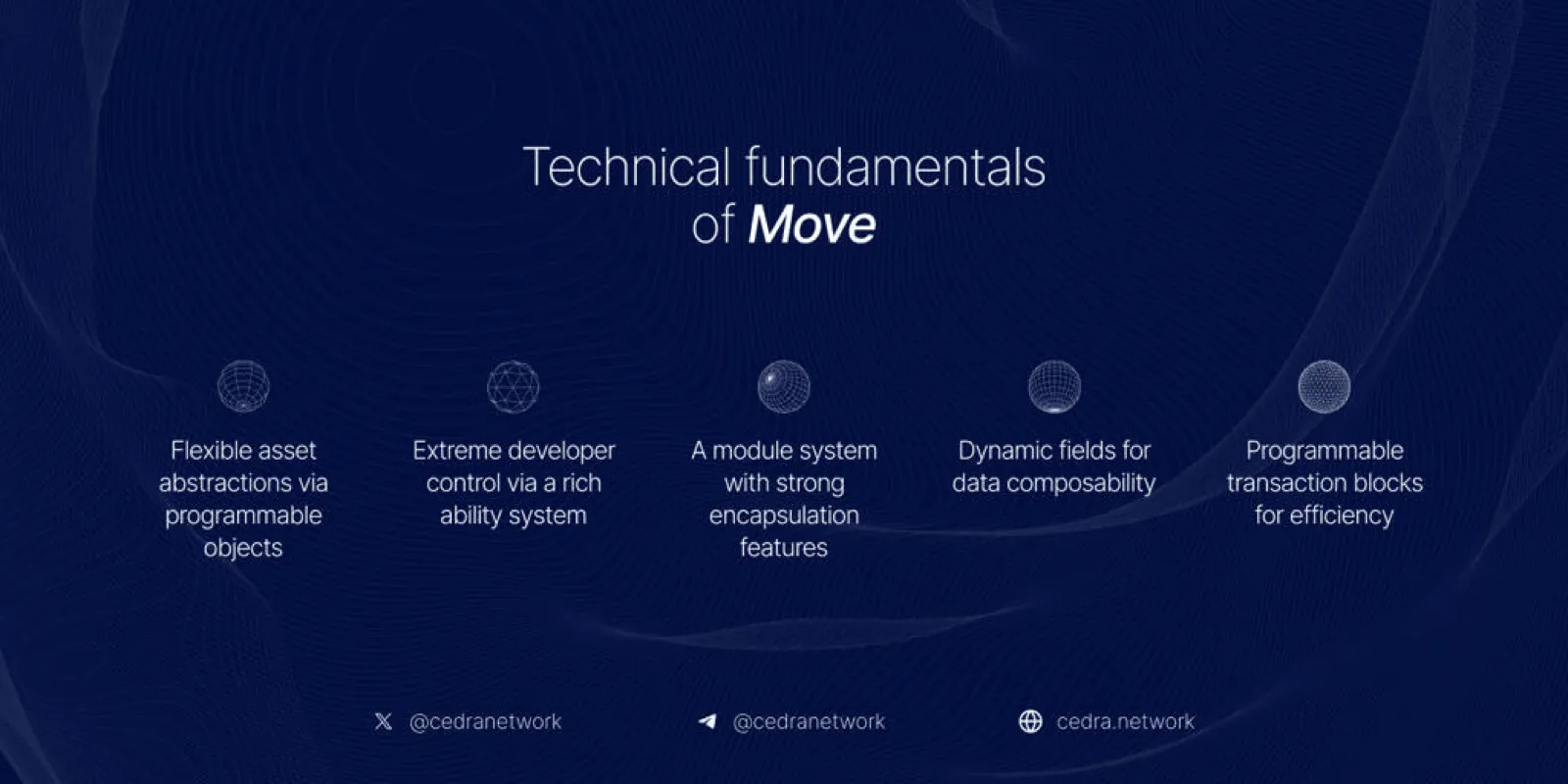
- Safe and flexible asset abstractions. The idea that digital assets behave like real-world objects is at the heart of Move: they cannot be copied, accidentally deleted, or created out of thin air. By treating them as programmable objects, developers can define custom asset types (coins, tickets, in-game items, etc.) and precisely dictate how they can be used.
- A rich ability system for fine-grained control. Abilities are traits that define what operations are permitted on a given value, and through them, Move allows developers to control asset behavior. This reduces the risk of logic errors and security vulnerabilities.
- Code reusability through a module/ system. The code in Move is organized by modules with strong encapsulation, meaning that assets remain under the strict control of their defining module when the code is reused for other modules.
- Dynamic fields for intuitive hierarchies. Dynamic fields work exclusively with objects, allowing you to model complex data structures by attaching them to an existing object at runtime.
- Programmable transaction blocks (PTBs) for improved usability. Thanks to an innovative approach with PTBs, users can safely combine actions across modules without developers having to predefine every possible combination.
Move vs. Solidity
While Ethereum-backed Solidity is a dominant smart contract language at the moment, Move has the potential to outperform it thanks to its built-in security, efficiency, and formal verification.
Here’s a brief overview of how Move compares to Solidity:
- While Solidity bundles objects together, Move sees them as resources that can be moved around. This corresponds to the Move’s philosophy of being closer to physical reality.
- As opposed to contract-based storage, Move opts for account-based one, meaning that assets are stored directly within an individual account’s storage, rather than being centralized in a contract.
- Move is dedicated to ensuring the utmost security (it’s fully protected from 5 out of OWASP’s top 10 smart contract vulnerabilities, and 3 more are partially mitigated), while Solidity remains more exposed to hacks and exploits.
- In terms of adoption, Solidity offers a more mature ecosystem and active community compared to Move, which is only gaining its traction. This is the major stumbling block for Move, as it lacks tooling maturity and often requires piecing together bits from fragmented resources.
Cedra as a missing puzzle: a cooperative infrastructure for Move

As we’ve mentioned, Move hasn’t yet reached Solidity’s level of popularity despite clear safety and technical advantages—all because of a smaller ecosystem. Here’s where Cedra can enhance access to this technology and remove barriers for developers, especially newcomers.
Cedra is a public-good, community-backed blockchain that lets everyone create distributed networks using Move. It provides extensive documentation for developers to learn about how Move works, as well as examples of real projects (such as decentralized exchange platforms or NFT contracts) that can be built on Cedra.
Key benefits of Cedra
With the spirit of fairness, open collaboration, and rapid iteration, Cedra offers developers the following:
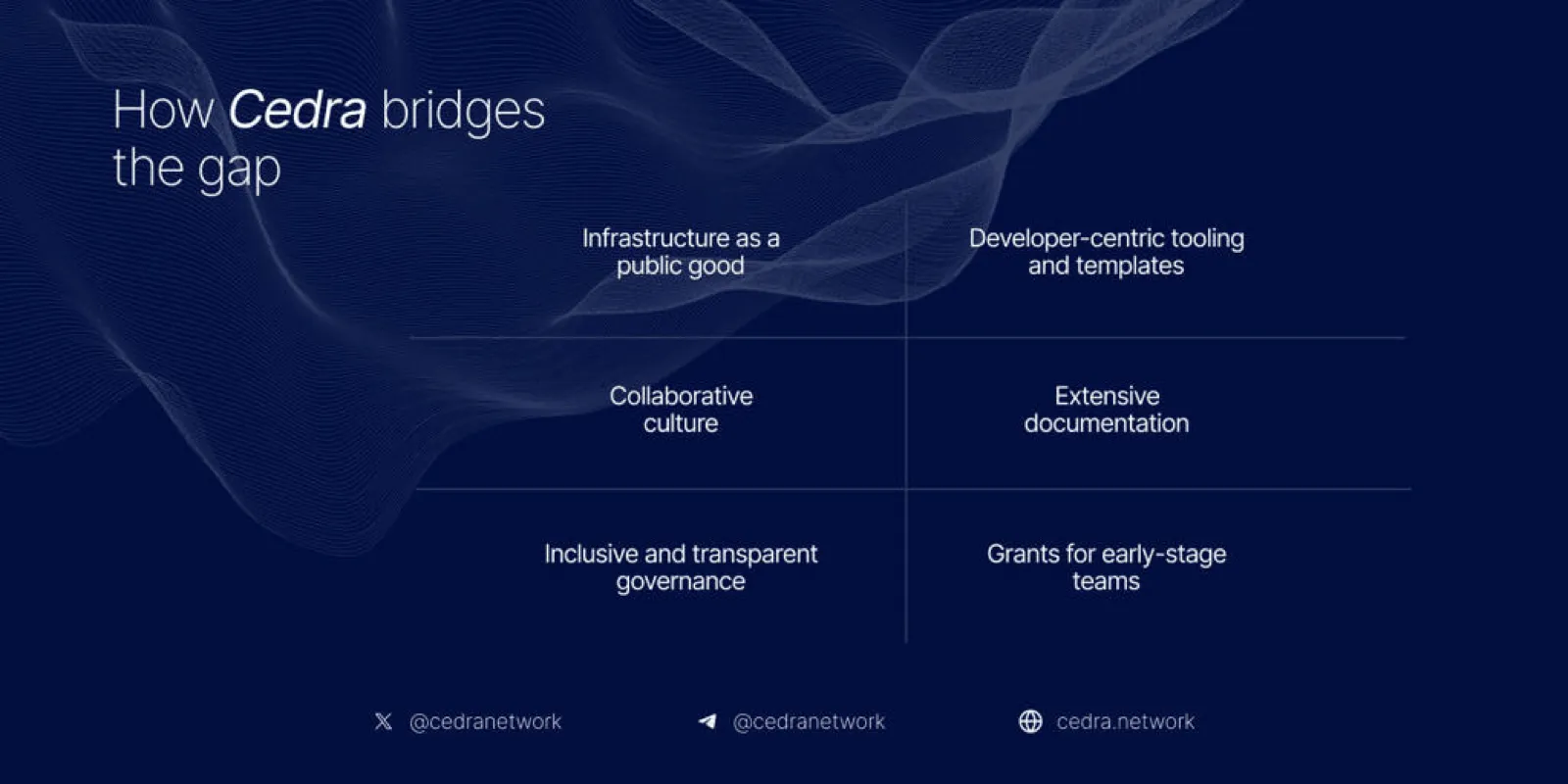
- Developer-centric resources. With structured documentation, pre‑audited Move templates, and other helpful tools, Cedra lets developers get to know Move and quickly and efficiently apply their knowledge in production-ready solutions.
- Grants for early-stage teams. The platform offers grants, ranging from $5,000 to $25,000, that can help new teams validate ideas and accelerate time-to-mainnet.
- Collaborative culture. Part of Cedra’s mission is to combine high-performance tech with radically open governance so that contributors see real impact. Governance happens transparently—via public discussion, GitHub proposals, and on-chain voting.
- Infrastructure as a public good. Finally, Cedra proposes a vision where all participants equally benefit. It’s a transparent approach that aligns with its core principle of public good and allows for sustainable scaling.
To sum up
Move is a next-generation smart contract language—secure by design, verifiable, and built around the principle that digital assets should behave like physical ones. Compared to Solidity, it has far fewer vulnerabilities and some innovative execution models that allow for unparalleled creativity and experimentation while maintaining a high level of control.
Its biggest drawbacks—a steep learning curve and a relatively sparse ecosystem—are surmountable. With Cedra network, we can expect that more projects will embrace Move language with confidence. It’s designed to provide developers with the necessary resources and create an empowered, transparent community where every contributor matters.
If you believe in the promise of Cedra and the power of Move, we invite you to join the community!