Cedra is a public goods infrastructure layer for building secure, community-owned products powered by the Move programming language. Cedra combines the advantages of Move with ready-to-use guides for developers, allowing for safer and faster deployment of FAs, NFTs, fee splitters, escrow contracts, and other solutions.
4 Things You Can Build With Cedra
Let’s explore 4 real-world applications of Cedra and see how these smart contracts can be used in Web3 and traditional environments.
1. Fungible assets
Fungible assets (FA) are interchangeably used for trade and exchange. They are one of the major components of both traditional and decentralized finances. With simple developer guides from Cedra, you can create FAs to serve as coins, tokens, or in-app credits for a variety of purposes and niches.
Why it’s better with Cedra
Cedra blockchain is designed to utilize the smart contract language Move to its full potential, supplying it with the ecosystem it’s missing. While Solidity has a decent ERC-20 standard for building fungible assets, it’s prone to some vulnerabilities (mint exploits, phantom tokens, etc.).
By contrast, Move makes these issues impossible by design because a coin is treated as a resource that can’t be copied or destroyed. In turn, Cedra offers guides and tooling that make this tech more accessible, which means that you can launch projects with safer templates and less development and testing effort.
Practical use in Web3 and traditional industries
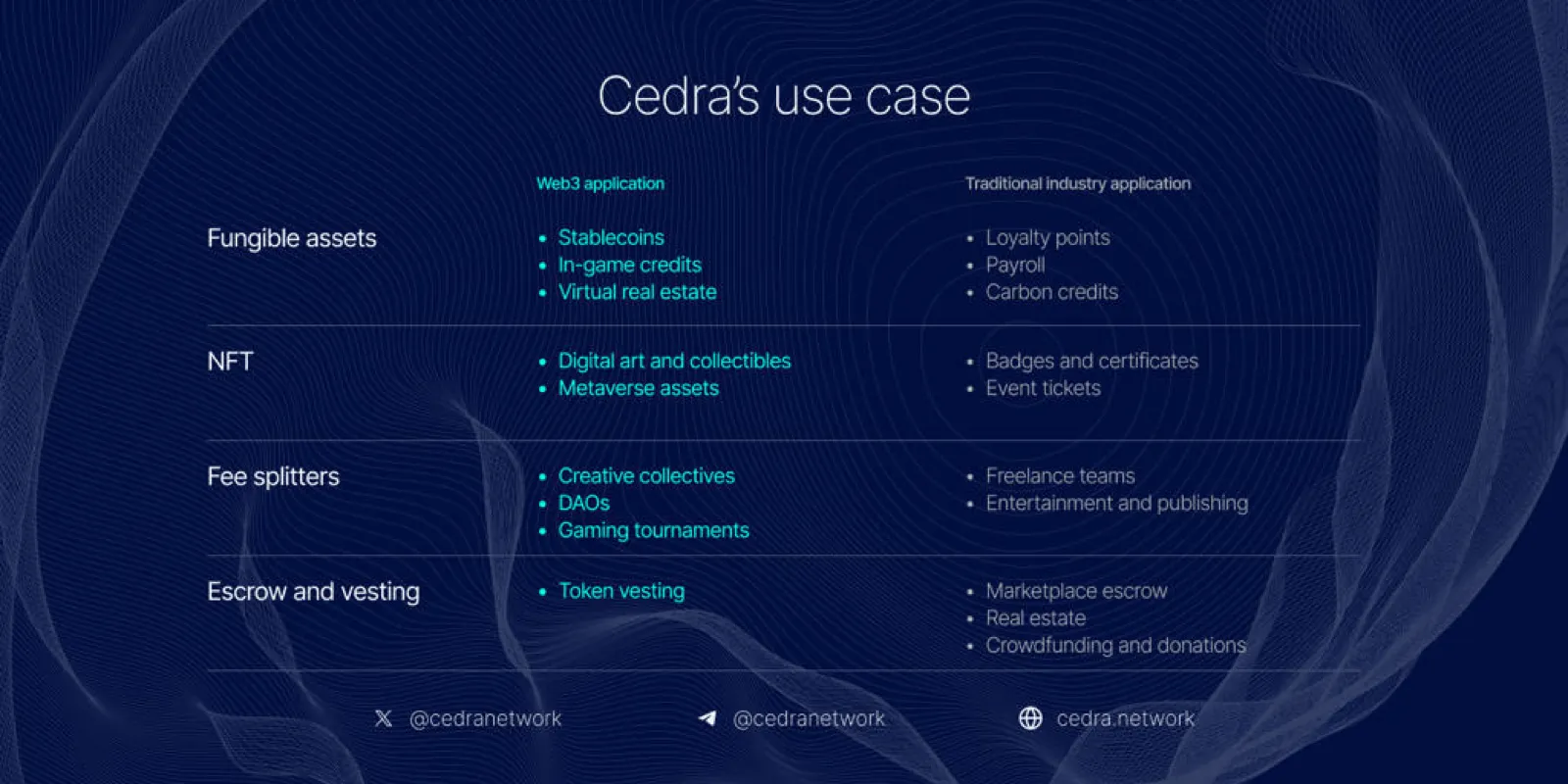
Cedra’s FA template can fit in the real world in a lot of ways—here are some of the examples of what you can create with it:
- Stablecoins. Quickly launch transparently-run currencies with metadata and per-account balance stores.
- In-game credits. Build customizable spendable credits for a range of games or apps.
- Loyalty points. Create various loyalty and reward solutions by combining FAs with fee-splitter modules.
- Payroll solutions. Leverage fungible tokens for automated salary payouts across global teams.
- Carbon credits. Tokenize environmental credits with transparent issuance and redemption rules.
- Grants. Design contracts for distributing funds to recipients with on-chain transparency.
Check out the FA guide and FA demo to see how it works in closer detail.
As you can see, you can develop different FAs without reinventing the wheel: Cedra provides a secure infrastructure and helps accelerate deployment. On top of that, you can combine your FA projects with other Cedra’s capabilities, such as escrow or fee splitter templates.
2. NFTs
Non-fungible tokens or NFTs are unique objects with their own metadata. They function as digital certificates that represent ownership of digital or physical assets. It’s come to be known in the world of digital art, but NFT technology can be applied to an array of things, be it metaverse items or event tickets.
Why it’s better with Cedra
Similarly to FA development, Move offers a more robust security model for NFTs compared to Solidity’s ERC-721 standard (where metadata can be mutable and tokens are implemented with a centralized, contract-focused approach).
Thanks to the resource-oriented nature of Move, Cedra’s NFT guide builds in unauthorized minting prevention and handles ownership validation, improving security and reducing gas fee costs.
Practical use in Web3 and traditional industries
Cedra’s practical guide to NFT contracts allows you to create the following types of projects:
- Digital collectibles. You can create verifiable NFTs and NFT collections with on-chain provenance tracking.
- Metaverse assets. NFT templates can be used for selling avatars, wearables, digital real estate, and other items that exist in Web3 ecosystems.
- Educational certificates. You can develop solutions for verifying licences, badges, and certificates given out for learning programs, corporate training, and anything else.
- Supply chain certificates. Similarly to educational certificates, you can create tokens of proof of authenticity to be used across suppliers and sellers.
- Event tickets. You can build NFTs that help manage the sales and ownership of real-world tickets for conferences, concerts, and other events.
Check out the NFT guide and NFT collection demo to see how it works in closer detail.
With Cedra’s NFT tutorials and Move’s built-in security features, one can develop transparently verifiable and attack-resistant NFT contracts. NFTs will be treated as unique resources and transfers will be handled with minimal gas costs.
3. Fee splitters
Fee splitter contracts (used to automate revenue distribution across multiple parties) can simplify the way royalties are paid out, partnership revenues are shared, or nonprofit donations are split across projects.
Why it’s better with Cedra
Cedra leverages the safety advantages of Move and enables performing all payouts on a single on-chain call instead of multiple ones. Compared to this, Solidity-powered contracts don’t make it possible for funds to be distributed automatically, which leads to manual actions, gas griefing attacks, or risks of funds being locked because of recipient inactivity.
With an example contract made by Cedra, you can use an already working code and adapt it to your needs. While you can create standalone contracts for revenue distribution, this tech stack also lets you easily integrate a free splitter module into other solutions (marketplaces, wallets, etc.).
Practical use in Web3 and traditional industries
From tournament rewards to NFT royalties and from marketplace fees to protocol partnerships, there are numerous ways you can utilize a fee splitter made with Cedra. For example:
- Creative collective revenues. Build contracts that automatically regulate streaming revenue across multiple creators.
- DAO payouts. Use fee splitters to simplify revenue sharing across DAO contributors.
- Gaming rewards and tournaments. Automate prize distribution for competitive play.
- Agencies and freelance teams. Ensure transparent revenue distribution across remote collaborators.
- Royalty split in entertainment and publishing. Introduce solutions to streamline payouts for musicians, authors, and other actors involved in their fields.
Check out the fee splitter module and fee splitter demo to see how it works in closer detail
Cedra’s guidance to fee splitters can help you build transparent contracts to automate various payouts according to set rules. These contracts can be a perfect fit for both cryptoeconomics and traditional industries, especially those niches that deal with creators and collectives. Powered by Move that outperform Solidity in security and gas usage, fee splitters on Cedra are also super-easy to deploy and integrate with other projects.
4. Escrow contracts
Vesting schedules and escrow mechanisms (used to release tokens or other funds after certain conditions are met) play a crucial role in peer-to-peer economies, ensuring a trustworthy process for all parties.
Why it’s better with Cedra
Just like other use cases we’ve mentioned, vulnerabilities in Solidity-powered contracts can lead to escrow scams and vesting exploits, which are technically impossible on Move. Cedra’s code template lets you build simple and time-locked escrow contracts: with the former, fund release happens manually, while the latter unlocks funds after a specified period of time or event.
Practical use in Web3 and traditional industries
Here are some ideas of what Cedra can enable you to create:
- Token vesting contracts. Set up a system to release tokens according to a schedule.
- Marketplace escrow. Create a feature that holds funds until a buyer confirms delivery of goods or services.
- Real estate deals. Assist traditional property businesses to keep deposits in escrow until contractual conditions are satisfied.
- Crowdfunding solutions. Develop a platform that locks contributions until a funding goal or milestone is reached.
- Donation management. Design modules that ensure that donated funds are released only when specific project milestones are verified.
Check out the escrow contract template to see how it works in closer detail.
Cedra provides an easy-to-use template for customizing the escrow mechanics, which can be applicable to different settings and save businesses dealing with trustless agreements. Cedra also offers a flexible frontend integration, perfect for building dashboards and user interfaces at no additional gas cost.
To sum up
With Cedra as an infrastructure layer and Move as a secure smart contract language, you can easily build and integrate products for both Web3 and traditional industries. Cedra makes it practical by giving you ready-to-use code guides and a composable stack for combining different modules.
Want to start building projects on Cedra and seeing how this tech performs in real-world environments? We invite you to join our community!