In this Cedra Talks episode, core contributors came together to answer questions from the community and share insights into the project’s direction.
Hosted by Diana King, core marketing contributor at Cedra, the conversation features Vlad Serdyukov, core ecosystem contributor, and Yaro Dvorovenko, DevRel contributor.
The discussion covers Cedra’s roadmap, mainnet expectations, community involvement, and what defines success for projects building within the ecosystem.
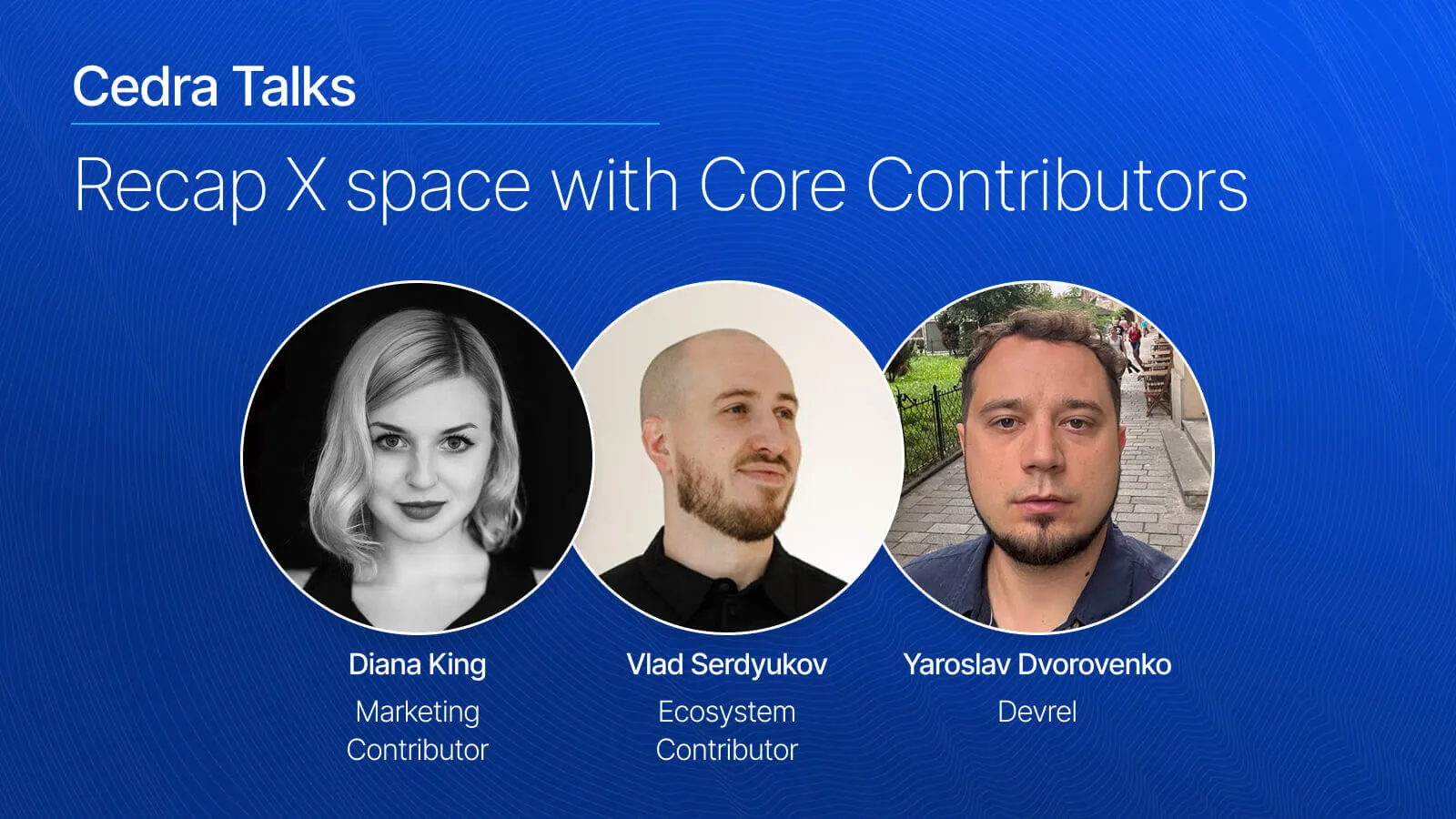
Diana: Welcome everyone, and thanks for joining us today. We’re here with Cedra’s core contributors to answer your questions and share updates on what’s ahead.
Let’s start from the beginning. Vlad, could you introduce yourself and tell us about your role?
Vlad: Thanks, Diana. I’m Vlad, and I focus on business development for Cedra. My role involves finding new projects, building partnerships, and bringing strong teams into the ecosystem. I work closely with founders, explore opportunities for collaboration, and help shape strategies that grow the network.
We’re always looking for interesting projects and builders who can contribute to Cedra’s expansion.
Diana: Let’s address the most frequently asked question: when is the mainnet launch, and what are the plans around it?
Vlad: That’s definitely the most popular question right now. At the moment, we’re orienting towards a launch in Q3–Q4 this year. We want the launch to be smooth and impactful, with a strong ecosystem already in place. Market conditions also play a role but our priority is to launch with quality and momentum. If anything changes, we’ll communicate it through our official channels.
Diana: How can the community support Cedra and contribute to its growth?
Vlad: The biggest contribution is being active. Engage with our content, participate in discussions, and help spread awareness. Even simple actions like commenting or sharing posts make a difference.
Beyond that, builders can contribute by launching projects. If you have an idea, reach out to the team and start building — that’s one of the most valuable ways to support the ecosystem.
Diana: Are there any open roles or ways for people to join as contributors?
Vlad: We don’t have specific open roles right now, but we’re always open to talent. If you have skills and want to contribute, reach out directly. Many contributors start by simply getting involved and proving their value.
Diana: We also welcome interns, especially in marketing and business development. These roles are currently unpaid, but they’re a great way to gain experience and grow with the ecosystem.
And Yaro just joined us, welcome! Could you briefly introduce yourself?
Yaro: Hi everyone. I work on documentation, developer onboarding, hackathons, and supporting projects within the Cedra ecosystem. I also collaborate closely with builders and help them navigate the development process.
Diana: Will we see a public roadmap soon?
Yaro: Yes, but it’s flexible. We’re planning a pre-mainnet phase, and based on its results, we’ll refine and publish a roadmap. Transparency is important, especially for builders, so we’ll definitely share it publicly.
Diana: Are there new educational or builder programs planned?
Yaro: Yes. The next iteration of our builder program will be much bigger. The first season was more experimental, but the next one will focus on external projects building real products, with significantly more participants.
Diana: What types of projects are you most excited about?
Yaro: AI is a major focus right now in the whole web3 space, especially AI agents and AI-driven products. There’s still a lot of unexplored potential there.
Vlad: In addition to AI, we’re also interested in DeFi, aggregators, and any projects that can drive real activity and usage. Even if it’s not AI-related, strong ideas with real traction are always welcome.
Diana: What defines a successful project on Cedra?
Yaro: It’s about community and value. A successful project solves real problems and delivers meaningful value to its users.
Vlad: From my perspective, success is when a project attracts attention not just within Cedra, but across the entire Web3 space.
Diana: For me, success is when a project becomes self-sustaining infrastructure — something people use naturally, without heavy promotion.
We focus on real communities, not artificial growth. Even a small but engaged group can grow into something significant over time.
During the session, community members also shared feedback on launch timing and strategy. One key takeaway is that while market conditions matter, Cedra is actively working toward launching its pre-mainnet as soon as possible, focusing on readiness and long-term impact.
This session highlighted Cedra’s core philosophy: build in public, prioritize real value, and grow through community-driven contributions.
With a focus on builders, upcoming programs, and a carefully planned mainnet launch, Cedra is positioning itself as an ecosystem shaped by its users.
Whether you’re a developer, contributor, or supporter, the message is clear: stay active, keep building, and be part of what comes next.
Join the ecosystem: https://linktr.ee/cedranetwork